NCERT Solutions for Class 6 Science Chapter 2 – Diversity in the Living World help students understand the chapter in a simple and effective way. Class 6 Science Chapter 2, Diversity in the Living World, introduces the amazing variety of living organisms found on Earth. Students learn about the characteristics of living things, the differences and similarities between plants and animals, and how scientists classify organisms into different groups.
This chapter also explains the importance of biodiversity and how living organisms adapt to their surroundings. With clear explanations and step-by-step answers, these NCERT Solutions for Class 6 Science Chapter 2 make learning easier and help students build a strong foundation in science.
By practising these solutions regularly, students can improve their understanding of important concepts, revise the chapter quickly, and prepare confidently for school exams. These solutions follow the latest NCERT Class 6 Science textbook and are useful for completing homework, clearing doubts, and scoring better marks in exams.
Download NCERT Solutions for Class 6 Science Chapter 2 – Diversity in the Living World
Download NCERT Solutions for Class 6 Science Chapter 2 (Diversity in the Living World) in a clear, free and easy-to-access PDF format.
Chapter 2 – Diversity in the Living World
NCERT Class 6 Science Chapter 2 – Diversity in the Living World Solutions
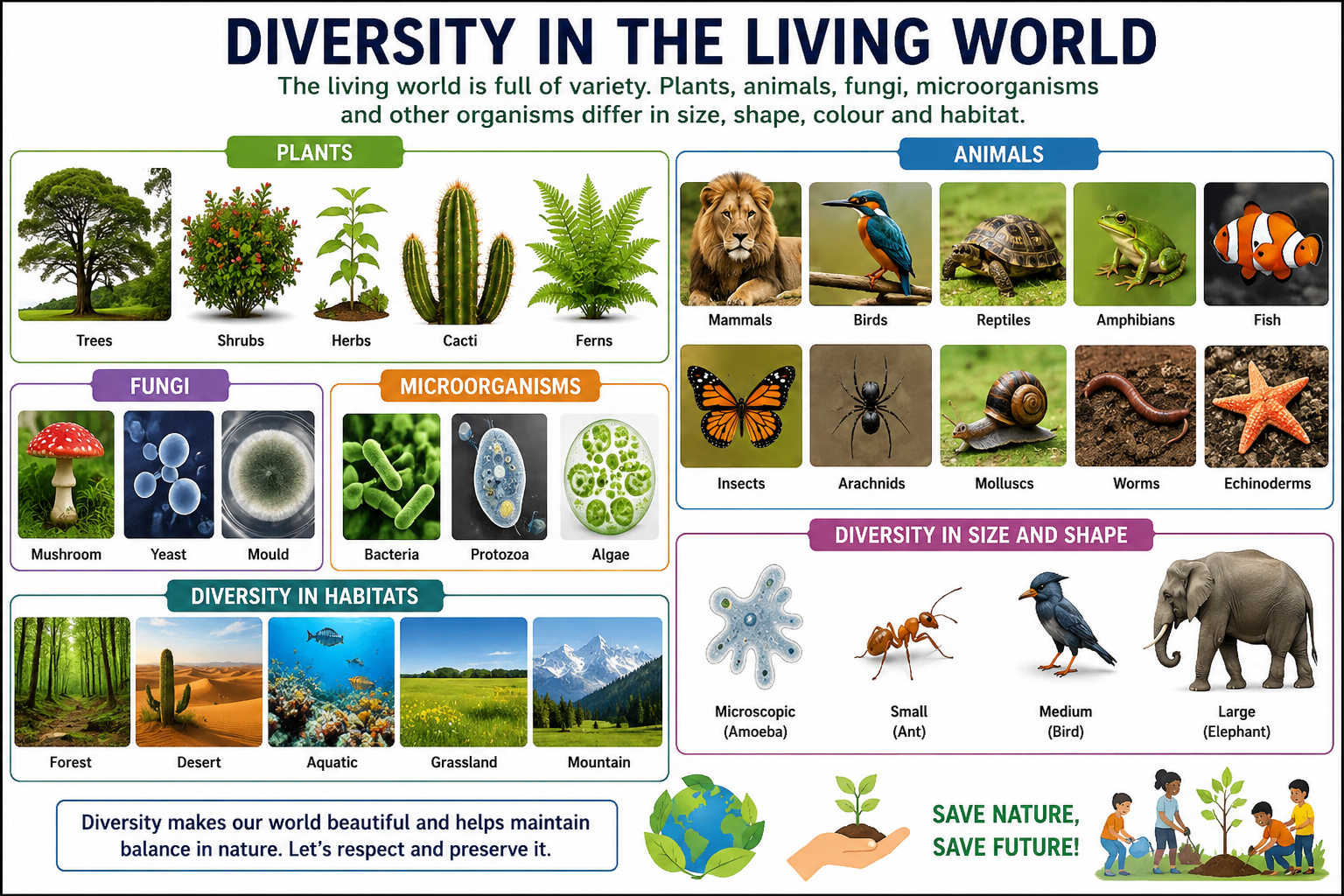
- Biodiversity means the variety of plants, animals, and other living organisms found on Earth.
- Nature has many different kinds of plants and animals, each with unique features and characteristics.
- Plants differ in their height, stem, leaves, flowers, and roots, while animals differ in size, shape, food habits, movement, and habitat.
- Grouping helps us study and identify plants and animals more easily based on their similarities and differences.
- Plants are grouped into herbs, shrubs, and trees according to their height, stem type, and branching pattern.
- Some plants are climbers, which need support to grow, while creepers spread along the ground.
- Leaves show two main types of venation:
- Reticulate venation (net-like veins)
- Parallel venation (parallel veins)
- Plants have two main types of roots:
- Taproot
- Fibrous root
- Plants with reticulate venation usually have taproots, while plants with parallel venation usually have fibrous roots.
- Based on seeds, plants are classified into:
- Dicots (two cotyledons)
- Monocots (one cotyledon)
- Animals can be grouped according to their movement, such as walking, flying, swimming, crawling, hopping, or jumping.
- Different animals use different body parts like legs, wings, fins, or muscles to move.
- Different regions such as deserts, mountains, forests, and oceans have different plants and animals because environmental conditions vary.
- Adaptations are special features that help plants and animals survive in their surroundings.
- The natural place where an organism lives is called its habitat. Habitats provide food, water, air, and shelter.
- Habitats are mainly of two types:
- Terrestrial (land)
- Aquatic (water)
Some animals, like frogs, are amphibians because they live both on land and in water.
- Damage to habitats due to human activities causes a loss of biodiversity and threatens many species.
- India has conservation programmes such as Project Tiger and the Cheetah Reintroduction Project to protect endangered wildlife.
- Sacred groves are community-protected forests that conserve many rare plants, animals, and medicinal species.
- Protecting biodiversity is essential to maintain ecological balance and ensure that plants and animals continue to survive and thrive.
Chapter 2 – Diversity in the Living World NCERT Textbook Solutions
Skip to PDF contentTo learn More NCERT Class 6 Science Chapter 2 – Diversity in the Living World Solutions
Watch Diversity in the Living World videos Here
What is the importance of grouping?
Grouping makes it easier to understand and study plants and animals on the basis of their similorities and sifferences.
What is leaf veins?
The lines on the leaf are called veins.
What is leaf venation?
The design made by veins in a leaf is called leaf venation.
Daily Current Affairs